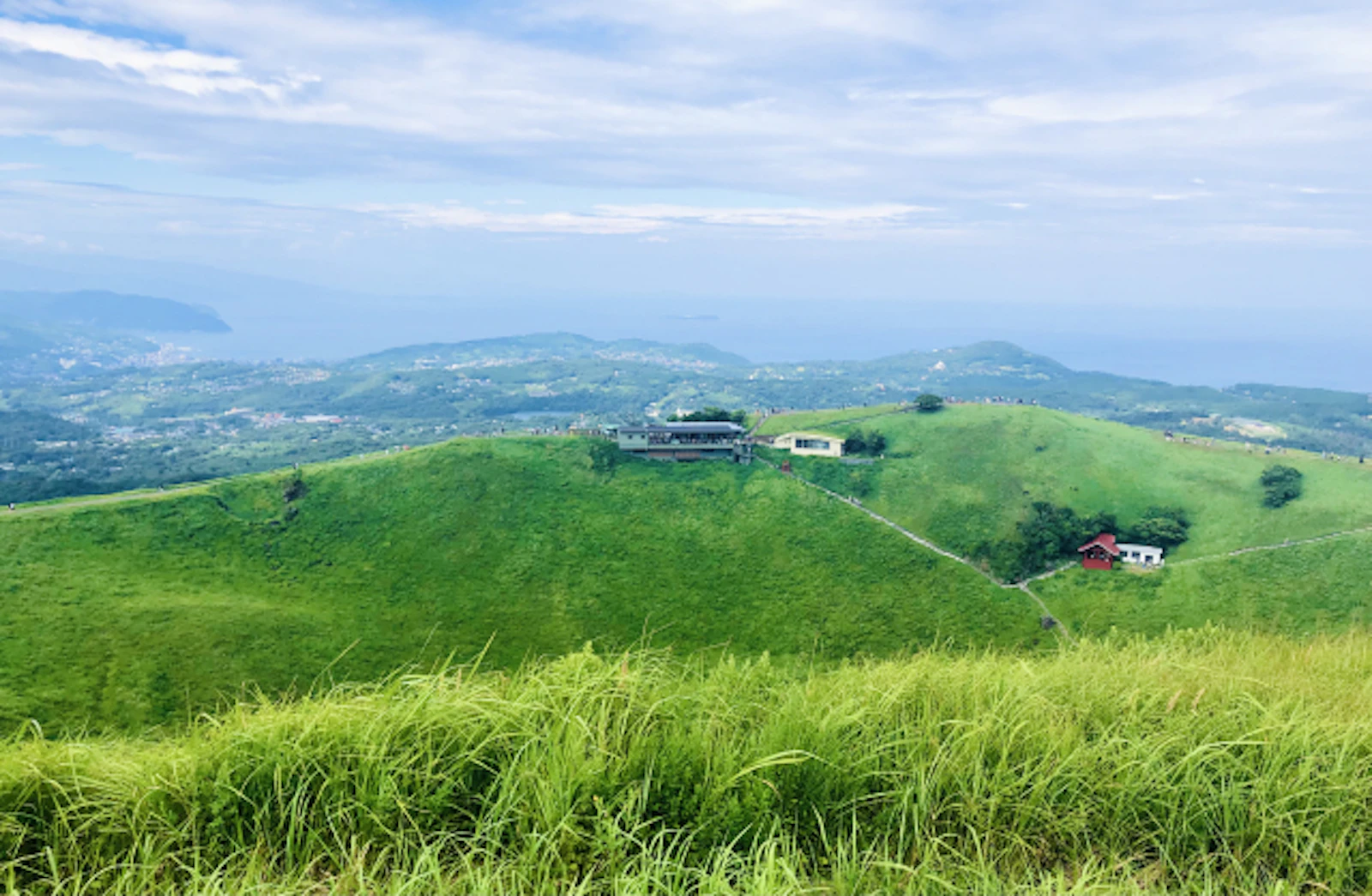
Mount Omuro is a volcano formed by an eruption approximately 4,000 years ago.
It is a “scoria cone” formed by layers of volcanic ejecta, and its distinctive shape—resembling an upside-down bowl—is also the result of this volcanic activity.
It stands at an elevation of 580 meters.
At the summit is a crater approximately 1 kilometer in diameter, and visitors can now walk around its perimeter on the “O-hachi Meguri” trail.
On a clear day, you can enjoy a 360-degree panoramic view of Mount Fuji, the Izu Islands, and Sagami Bay.
In other words,
it’s now a symbol of Ito as a “scenic spot,” but it was originally a volcano formed about 4,000 years ago
, isn’t it?
There is an Asama Shrine at the summit
At the summit of Mt. Omuro stands the “**Mt. Omuro Sengen Shrine**.”
Here, deities known for ensuring safe childbirth and fostering romantic relationships are enshrined, and it remains a place where visitors can stop by while walking around the crater rim at the summit. The official
Ito City tourism website states that Konohanasakuya-hime and her sister, Iwanaga-hime-no-mikoto—who are enshrined at Fujisan Hongu Sengen Taisha—are enshrined here.
While most Asama Shrines typically enshrine the younger sister, Konohanasakuya-hime-no-Mikoto, Omuroyama is unusual in that it enshrines her older sister, Iwanaga-hime-no-Mikoto, alone.
The “Mountain Burning” Festival Has Been Held for Over 700 Years
The most fascinating aspect of Mt. Omuro is the “Mt. Omuro Yama-yaki,” held every February.
This event has a history of over 700 years.
At first glance, burning the entire mountain may seem like a rather unusual event, but it was originally carried out for the purpose of preserving the mountain and maintaining grazing lands.When it began
approximately 700 years ago, it was part of daily agricultural and domestic life,
aimed at cultivating high-quality thatch used for thatched roofs, compost, and livestock feed. Today, it has become a spring tradition in Ito.
By burning the mountain’s grass once a year, new grass grows, preserving that distinctive **“Mount Omuro, resembling a green pudding”**.
In other words, the beautiful landscape we see today
not simply a landscape left to nature, but one that local people have carefully tended and maintained over a long period of time
.