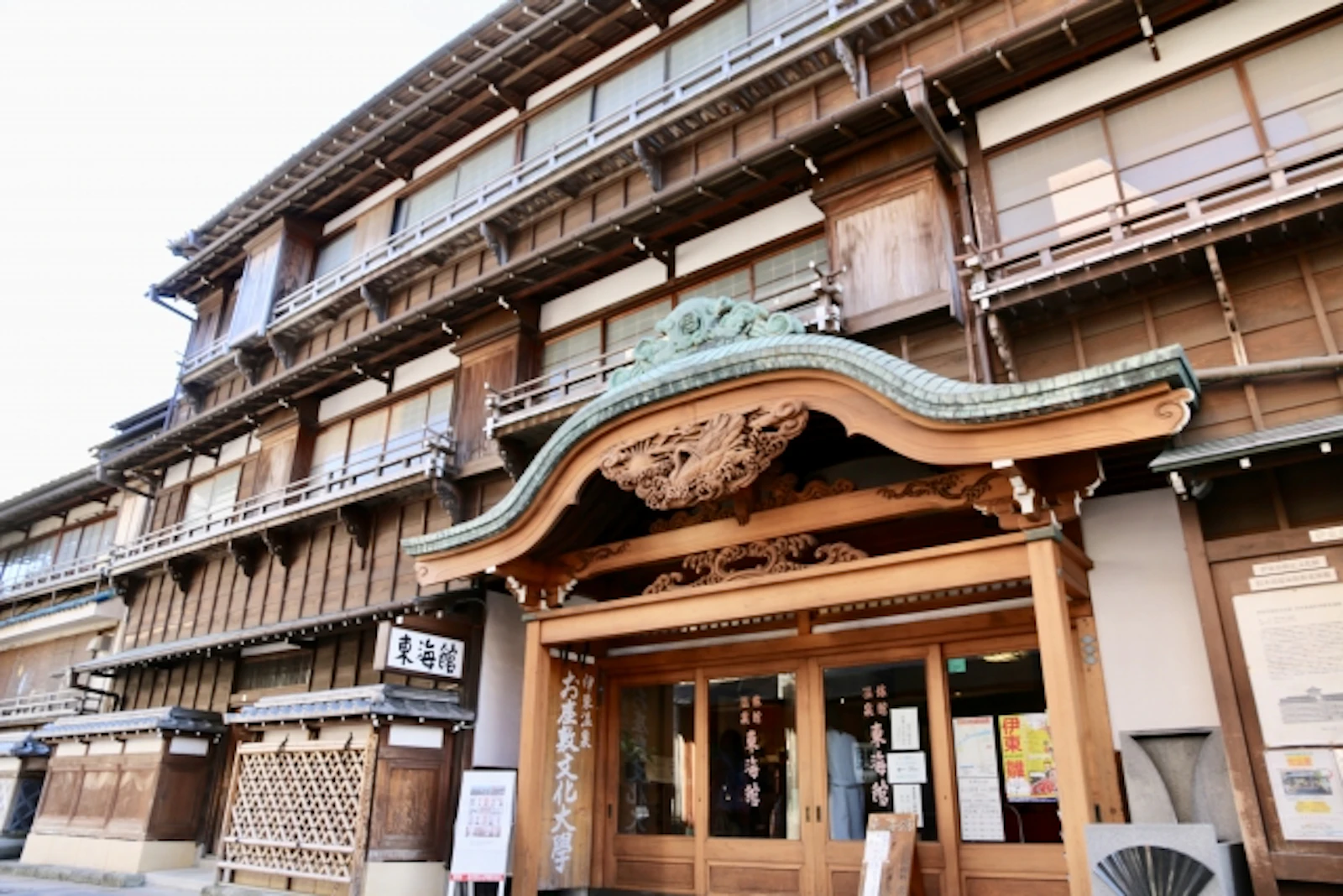
Along the Matsukawa River, which flows through the center of Ito, stands a particularly eye-catching wooden building.
It is the Tōkaikan.
Although it is currently open to the public as the “Ito Onsen Tourism and Cultural Facility Tokai-kan,” it was originally a hot spring inn established in 1928 (Showa 3).
Built by Antaro Inaba, a lumber merchant, it operated as an inn for approximately 70 years.
From the outside, it is an impressive three-story wooden structure.
However, the appeal of Tokai-kan lies not only in the size of the building.
Once inside, you can see the intricate details crafted by the artisans of that era everywhere you look.
It’s as if Ito Onsen itself from that era has been preserved within the building.
If you walk around with that sense in mind, Tokai-kan begins to look a little different.
1928: The Birth of Tokai-kan
Tokai-kan was founded in 1928, just as the Showa era was beginning.
Since the founder, Antaro Inaba, was a lumber merchant, the building features high-quality wood and “unusual timber” that makes the most of its natural shape.
Even today, visitors can see pillars and beams with beautiful wood grain, as well as uniquely shaped pieces of wood, throughout the building. The city of Ito also highlights Tokai-kan as a building where one can appreciate the craftsmanship of the era in its “notable and unusual woods,” architectural fittings, and intricate details.
How to showcase the wood, and where and how to incorporate decorative elements—
The work of these artisans itself is what makes this building so captivating.
The Opening of the Ito Line Brought Major Changes to Tokai-kan
The opening of the Ito Line in 1938 (Showa 13) is a pivotal event in the history of Tokai-kan.
According to the City of Ito, the opening of the Ito Line shifted the clientele—which had previously consisted mainly of visitors seeking hot spring treatments—toward group tourists, and Tokai-kan expanded its facilities accordingly.
In other words, the Tokai-kan building itself reflects the changing demographics of visitors to Ito Onsen.
The inn did not expand simply because it wanted to build a more impressive structure.
Railroads changed the way people traveled, and the nature of hot spring trips evolved as well.
In response to these changes, Tokai-kan also evolved.
A Showcase of Artisans’ Craftsmanship Remains Within the Inn
As you walk through the inn, you’ll notice that the atmosphere varies slightly from room to room.
This is one of Tokai-kan’s major highlights.
It is said that renowned master carpenters of the time each took responsibility for a different floor during construction, and you can see distinct designs in each area.
For example, the decorative windows in the guest rooms.
The staircase handrails. The shoji screens in the study. The floor pillars. The transom panels.
And the wood used throughout the building.
While each element may seem like a small decorative detail on its own, together they create the unique atmosphere of Tokai-kan.
The 120-tatami-mat grand hall is particularly breathtaking.
It allows us to imagine that ryokans of that era were not only places for individual travelers but also venues where large numbers of people gathered.
In 1949, the “Watchtower” was built on the rooftop
When viewed from the outside, the “watchtower” atop the building is what catches the eye.
It was built in 1949 (Showa 24).
At that time, there were few tall buildings around Tokai-kan like there are today, and it is said that one could see Mount Amagi from the watchtower.
While it is now a distinctive feature that embodies the “essence of Tokai-kan,” it also serves as a clue to imagining what the town of Ito looked like back then.
As you walk along the Matsukawa River today,
it might be interesting to wonder,
It might be interesting to ponder this.
Surviving Disasters and Continuing as a Ryokan
has continued to operate as a ryokan, and has undergone repeated repairs and renovations to keep pace with the times.
In 1958 (Showa 33), it suffered extensive damage from the Kano River Typhoon.
Nevertheless, thanks to subsequent repairs and renovations, it continued to operate as a ryokan.
Counting from its founding in 1928, Tokai-kan operated as a hot spring inn in Ito for approximately 70 years.
Then, in 1997,
It brought its long history as a ryokan to a close. The building was subsequently donated to the City of Ito.
From a Ryokan to a Cultural Facility
This marks the beginning of another chapter in Tokai-kan’s history.
Just because it had fulfilled its role as a ryokan didn’t mean the building was demolished.
In 1999, it was designated as a cultural property of Ito City, and preservation and restoration work was subsequently carried out.
Then, on July 26, 2001,
“Ito Onsen Tourism and Cultural Facility: Tokai-kan”
.
In other words, the current Tokai-kan is
was established in 1928 as a
hot spring inn
expanded in 1938
to accommodate the increase in group tourists following the opening of the Ito Line
In
1949, the observation tower was built
1997
: Ceased operations as a ryokan
In 1999, it was designated as a
cultural property of Ito City
2001
: Reborn as a tourism and cultural facility
After this long journey, it has taken on its current form.
As you walk through Tōkaikan, the history of Ito Onsen comes to life
The charm of Tokai-kan cannot be fully explained simply by saying, “It’s a Showa-era retro building.”
Here,
the history of how this hot spring resort developed
the era when the railway brought an increasing number of travelers
the skills of the artisans who supported the ryokan
and the efforts of those who sought to preserve the building after it had served its original purpose
are all intertwined here.
So, as you walk through the inn, please don’t just take photos of the rooms—be sure to take a closer look at the intricate details of the wood as well.
The grain of the wood on the pillars.
The banisters on the stairs.
The shape of the windows.
The design of the shoji screens.
The carvings on the transoms.
As you look at each of these elements, you gradually come to realize that Tokai-kan is not merely an “old inn,” but a work of architecture that people of that era created with great time and effort.
And by preserving the building, we today can imagine what Ito Onsen was like in the early Showa period.
If you visit Tōkaikan, be sure to take a walk along the Matsukawa River
If you’re visiting Tokai-kan, I recommend taking the time to view the exterior from along the Matsukawa River, not just exploring the interior.
The landscape created by the Matsukawa River, Tokai-kan, and the surrounding historic buildings is one of the scenes that symbolizes present-day Ito Onsen.
In fact, in July 2026, the city of Ito designated this area as an “Important Scenic District.” It has positioned the landscape—where the Matsukawa River and
historic structures like Tokai-kan blend as one—as an iconic symbol of Ito Onsen.
Explore the interior of the building.
↓
Take a walk along the Matsukawa River.
↓ Take
another look at Tōkaikan from the outside.
If you walk in this order, it might look a little different than when you first saw it.
Tōkaikan, which served as a model for *Thermae Romae*
There’s another interesting story about Tōkaikan.
Tōkaikan is known as one of the models for “Ito Onsen Tōrinkan,” which appears in Volume 4 of Mari Yamazaki’s manga *Thermae Romae*.
If you visit the actual Tōkaikan and then reread the manga, you’ll be able to enjoy the experience even more by comparing the atmosphere of the building with the one in the story.
*Thermae Romae* is a story about Lucius, an ancient Roman bath designer, who time-travels to modern-day Japan’s public bathhouses and hot springs and is amazed by Japanese bathing culture.
An Ito hot spring inn appears in this manga that bridges the “baths” of ancient Rome and Japan.
With that in mind, it might be interesting to read the manga before visiting Tōkaikan.